




Kayaking has become an alternative to conventional trajineras for exploring the canals of Xochimilco, while also playing an important role in a shared economy model in the community that generates decent work and economic growth.
【Mexico City, INPS Japan=Guillermo Ayala Alanis】
As dawn breaks, the canals of Xochimilco reveal a side that few visitors know. The mist, illuminated by the first rays of sunlight, dominates the landscape between the canals and chinampas, harmonizing with the barely perceptible sound of the paddles propelling the kayaks.
Kayaking has become an alternative to the traditional trajinera tour for exploring the canals and enjoying the sunrise or sunset from a more intimate perspective. It is a way to explore the chinampa area quietly and respectfully, as it generates no waste, coexists without stress with the local fauna, and can navigate shallow areas where large boats cannot access.(P-19)|SPANISH|JAPANESE|
Rodrigo Nava is one of the young guides who organize group tours so that visitors can enjoy the activity to the fullest and in a safe way… “What we want is for them to take away the connection they can have with nature, with the water, with the sun, with the sunrise, which is something that is not so easy to describe until you experience it and understand what it is like to be here… to have a moment of tranquility, of peace, in which you are one with nature,” said Rodrigo, who has been working on these activities for two years, together with a group of friends. They founded the company Kayak Adventures, which offers tours in new, safe, and easy-to-handle boats.
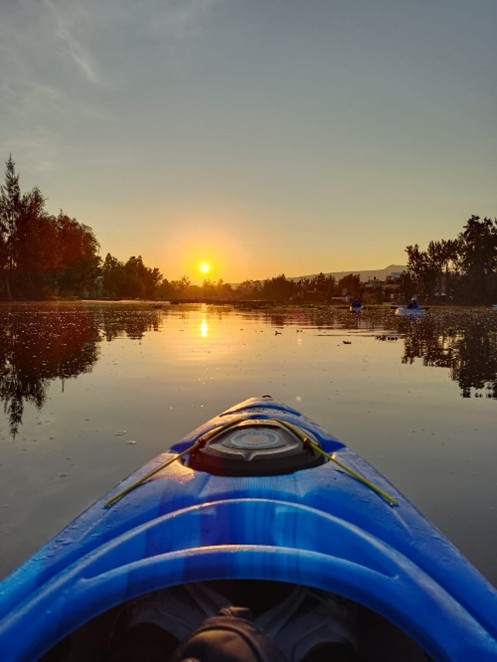
Lizbeth, who is a doctor by profession, took advantage of her day off to enjoy the experience… From a kayak, she could see the first rays of light emerging behind Iztaccíhuatl, one of Mexico’s most iconic volcanoes… “We live in a chaotic city, and constant stress every day becomes normal… It’s always a warm feeling to see the sun and its rays again,“ said Lizbeth, who attended with one of her friends and colleagues at the hospital, Esmeralda, who described seeing the sunrise as ”something very magical.“ ”My friend Lizbeth invited me, and I just had to say yes and wake up at 4 o’clock in the morning.”
Kayak Adventures organizes tours 365 days a year. Its services have gone international: they have welcomed tourists from Cuba, Colombia, the United States, and Venezuela. They also have guides who can communicate in languages such as English and Japanese. They are also specialists in accompanying beginners and nervous people… “They often tell us that they are anxious, afraid of sinking, and we help and accompany them through the process. We have had people who lose that nervousness or phobia of water or some anxiety problem,” said Rodrigo.
Kayaking trips are not a passing fad: they are part of a shared economy model in which local businesses, chinampa farming families, and young guides organize themselves to offer experiences that align with Sustainable Development Goal 8, Decent Work and Economic Growth. Through kayaking, the aim is to promote continuous, inclusive, and sustainable growth, fostering full and productive employment with work that is intertwined with care for the environment, the community, and local culture.
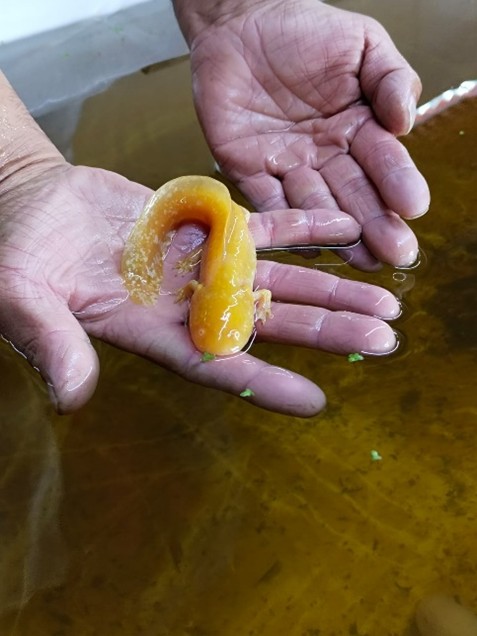
One example is the Ajolotario Apantli, which helps preserve the Mexican salamander (Ambystoma mexicanum), a species endemic to Xochimilco. Alejandro Correa, one of its managers, started the project with his family 25 years ago. His goal is to preserve this species and introduce new generations to the care and study of salamanders, as he has done. “It is an emblematic species in pre-Hispanic culture, which was used for food and medicine. People no longer knew about axolotls, but today it is a better-known species; more research is being done on it for its conservation and cultural dissemination… To me, it looked like a little water monster and, to a certain extent, it scared me.”
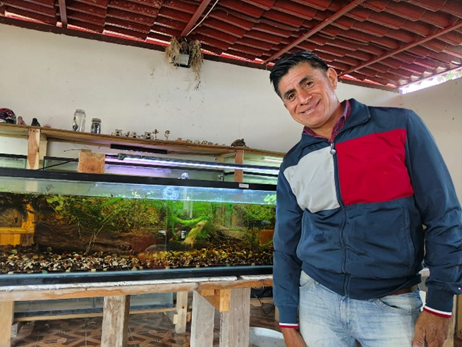
On the top floor of his house, Alejandro built a selective breeding center where he also researches different types of lineages and phenotypes of axolotls, such as black, pink, leucistic, and xanthophore, a type of golden axolotl.
The effort of getting up early, rowing, and visiting the axolotl farm whets the appetite. For this reason, Karen Pérez offers typical Mexican foods in her restaurant, made with products grown in local chinampas, such as corn, beets, carrots, spinach, and cactus. Karen explained that the benefits of collective work have driven joint progress. “Before, we worked individually, but looking at it closely, it’s better to work together because we go with the flower producers, with the kayakers, and they come with me… it’s a chain between us all and it strengthens us as a group.” Karen’s restaurant also serves as a venue for social events such as weddings and birthdays, or complements activities such as romantic dates or marriage proposals aboard a kayak.
Shared economy projects benefit the community by integrating different local businesses into a single service chain and seek to counteract intensive exploitation models in which investors acquire chinampas at low prices to convert them into places for mass cultivation or convert them into recreational spaces that generate noise, garbage, and waste, threatening the ecological balance of this area declared a World Heritage Site by UNESCO in 1987.
Bad practices not only threaten the community and Sustainable Development Goal 8, Decent Work and Economic Growth, but also affect Goal 11, Sustainable Cities and Communities, and Goal 15, Life on Land.
This article is brought to you by INPS Japan in partnership with Soka Gakkai International, in consultative status with UN ECOSOC.
INPS Japan
