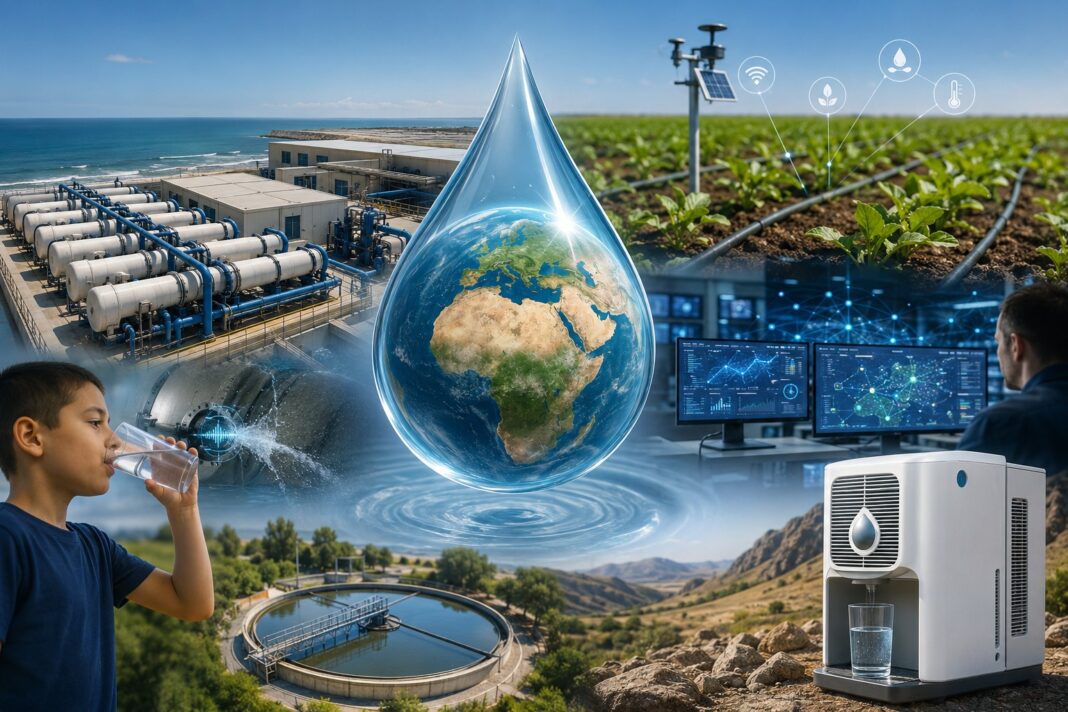
Water scarcity has become one of the defining challenges of the 21st century. But modern technology companies might find the way out for the whole of humanity. It also aligns closely with several of the United Nations Sustainable Development Goals (SDGs)
By Roman Yanushevsky

Jerusalem (INPS Japan) – Climate change, rapid population growth, urbanization, industrial expansion, and increasing pressure on freshwater resources have left billions of people facing water shortages. According to the United Nations, more than two billion people still lack reliable access to safely managed drinking water, while prolonged droughts and declining groundwater reserves continue to threaten communities across the globe.|JAPANESE|RUSSIAN|NORWEGIAN|
Israel understands this challenge better than most countries. Located in one of the world’s driest regions, the country has spent decades searching for ways to secure reliable water supplies for its population. What began as a national necessity gradually evolved into one of Israel’s greatest technological success stories. Through continuous investment in scientific research, engineering, and entrepreneurship, Israel transformed itself from a water-scarce nation into one of the world’s leading centers of water innovation.
Today, Israeli startups are developing technologies that help governments, municipalities, industries, and farmers manage water more efficiently. Their solutions are increasingly being adopted far beyond Israel’s borders, contributing to sustainable water management on every continent.
Reinventing Desalination Through Advanced Membrane Technologies
One of Israel’s greatest contributions to global water security is the advancement of membrane technologies used for desalination and water purification (performed by VP Membrane Technologies company).
Modern filtration membranes are capable of removing salts, bacteria, viruses, heavy metals, and microscopic contaminants while requiring less energy than previous generations of filtration systems. As desalination becomes more efficient and affordable, countries suffering from chronic water shortages gain access to new sources of safe drinking water.
Israeli engineers continue to improve membrane performance, extending their lifespan, increasing filtration capacity, and reducing operating costs. These innovations are making large-scale desalination more economically viable, particularly for regions facing severe freshwater shortages due to climate change.
Making Water Networks Smarter
Producing clean water is only part of the challenge. Around the world, enormous quantities of treated water are lost every day because of leaking distribution networks. In many cities, aging infrastructure allows between 20 and 40 percent of drinking water to disappear before it ever reaches consumers.
Israeli startups are addressing this problem by combining artificial intelligence, satellite imaging, cloud computing, and advanced sensors to create intelligent water management systems. These technologies continuously monitor water networks, identify hidden leaks, predict pipeline failures, and optimize water pressure throughout distribution systems.
Rather than responding only after a pipe bursts, utilities can now detect problems at an early stage, reducing both water losses and maintenance costs while improving the reliability of public water supplies.
Helping Agriculture Produce More with Less Water
Agriculture remains the largest consumer of freshwater worldwide, accounting for roughly seventy percent of global water use. As climate change increases pressure on agricultural production, improving irrigation efficiency has become essential.
Israeli innovation has long been associated with precision irrigation, beginning with the invention of modern drip irrigation and continuing through today’s digital farming technologies. Startups now combine soil sensors, weather forecasting, satellite imagery, artificial intelligence, and Internet of Things (IoT) devices to determine precisely when crops need water and exactly how much should be delivered.
Instead of applying fixed irrigation schedules, these intelligent systems respond dynamically to changing environmental conditions. Farmers are therefore able to increase crop yields while significantly reducing water consumption, fertilizer use, and energy costs.
Turning Wastewater into a Valuable Resource
Another area where Israeli startups are making significant contributions is wastewater recycling.
Rather than viewing wastewater as waste, Israeli engineers see it as an additional water source. New treatment technologies are making it possible to recycle municipal and industrial wastewater safely and efficiently for agriculture, manufacturing, and other non-potable applications. Some advanced treatment systems even support indirect potable reuse, further expanding available freshwater resources.
This approach not only reduces pressure on rivers, lakes, and aquifers but also supports the transition toward a circular water economy in which water is reused multiple times before returning to the environment.
Producing Drinking Water from the Air
Among the most innovative Israeli developments are atmospheric water generation systems capable of extracting drinking water directly from humidity in the air.
Using advanced condensation technology and highly efficient cooling systems, these devices convert atmospheric moisture into clean, safe drinking water without requiring traditional water infrastructure. Such systems are particularly valuable in remote communities, disaster zones, humanitarian emergencies, military operations, and regions where conventional water supplies are unreliable or unavailable.
As climate variability increases, atmospheric water generation may become an increasingly important complementary source of drinking water for vulnerable populations.
Digital Technologies Are Transforming Water Management
Artificial intelligence is reshaping every stage of the water cycle. Israeli startups have developed cloud-based digital platforms capable of integrating data from thousands of sensors installed in reservoirs, pumping stations, treatment plants, pipelines, and industrial facilities. These platforms continuously monitor water quality, forecast demand, optimize pumping operations, reduce energy consumption, and improve operational efficiency.
By transforming large volumes of operational data into actionable insights, digital water management enables utilities to make faster, more informed decisions while increasing the resilience of critical infrastructure.
Israeli Startups Driving Global Change
Israel’s water technology ecosystem includes hundreds of innovative companies working across virtually every aspect of water management.
Among the internationally recognized leaders is IDE Technologies, whose desalination and water treatment plants supply millions of people around the world with clean drinking water. Netafim, the pioneer of modern drip irrigation, continues to help farmers in more than one hundred countries improve agricultural productivity while conserving water.
Newer technology companies are expanding these achievements through digital innovation. WINT Water Intelligence uses artificial intelligence to detect leaks and monitor water consumption inside commercial buildings and industrial facilities. Utilis employs satellite technology to identify underground leaks that would otherwise remain invisible. Watergen has developed atmospheric water generators capable of producing drinking water directly from air humidity. Aquarius Spectrum focuses on acoustic leak detection for municipal water systems, while Kando applies artificial intelligence to wastewater monitoring and sewer network management. BlueGreen Water Technologies develops environmentally friendly biological solutions to combat harmful algal blooms and improve freshwater quality.
Together, these companies illustrate how Israeli entrepreneurship combines engineering, environmental science, robotics, artificial intelligence, and digital technologies to solve one of humanity’s most pressing challenges.
Supporting the United Nations Sustainable Development Goals

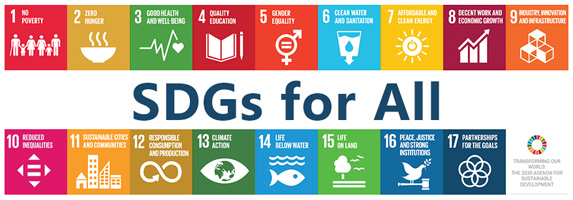
The work of Israeli water startups aligns closely with several of the United Nations Sustainable Development Goals (SDGs), demonstrating how technological innovation can contribute to global sustainable development.
Their most direct contribution supports SDG 6 – Clean Water and Sanitation, which aims to ensure universal access to safe drinking water, improve water quality, increase wastewater recycling, and promote efficient use of water resources. Desalination technologies, advanced filtration systems, wastewater recycling, and intelligent leak detection all contribute directly to these objectives.
These innovations also advance SDG 2 – Zero Hunger by enabling farmers to produce more food with less water through precision irrigation and smart agricultural technologies.
By developing advanced engineering solutions, digital infrastructure, and artificial intelligence for water management, Israeli companies support SDG 9 – Industry, Innovation and Infrastructure, strengthening resilient infrastructure and encouraging sustainable industrial development.
Smarter urban water networks contribute to SDG 11 – Sustainable Cities and Communities, while technologies that reduce waste and improve resource efficiency help achieve SDG 12 – Responsible Consumption and Production.
As climate change continues to intensify droughts and disrupt rainfall patterns, efficient water technologies also play an important role in SDG 13 – Climate Action, helping communities adapt to increasingly challenging environmental conditions.
Finally, Israeli companies actively collaborate with governments, international organizations, research institutions, utilities, and private-sector partners around the world, supporting SDG 17 – Partnerships for the Goals through the transfer of knowledge, technology, and expertise.
Looking Ahead
The global water crisis is expected to become even more severe in the coming decades. Growing populations, climate change, expanding cities, and increasing industrial demand will place unprecedented pressure on freshwater resources. Addressing these challenges will require not only new infrastructure but also continuous technological innovation.
Israel’s experience demonstrates how a country with limited natural water resources can become a global leader by investing in science, entrepreneurship, and engineering. Through advances in desalination, membrane technologies, precision irrigation, wastewater recycling, artificial intelligence, and atmospheric water generation, Israeli startups are helping reshape the future of global water management.
Their innovations are improving water security, strengthening climate resilience, supporting sustainable agriculture, and helping millions of people gain access to one of the world’s most essential resources. In doing so, they are not only addressing today’s water challenges but also contributing to a more sustainable and resilient future in line with the United Nations Sustainable Development Goals.

This article is brought to you by INPS Japan and Soka Gakkai International, in consultative status with UN ECOSOC.
INPS Japan
