

By Katsuhiro Asagiri and Rosario Liquicia
PHNOM PENH (INPS Japan) – Cambodia’s Buddhist community, nearly destroyed under the Khmer Rouge regime when most monks were killed, is still in the process of rebuilding. Today, the country has about 3,700 temples, with some 50,000 monks and 9,000 nuns engaged in reviving Buddhism and restoring traditional moral values.|JAPANESE|
Yet the Buddhist order is also being called upon to respond to a new set of challenges that emerged in the aftermath of civil war: rampant materialism, human trafficking, the earlier onset and growing casualization of sexual behavior, and the spread of HIV/AIDS. Against this backdrop, the role of monks as custodians of traditional morality is once again attracting attention.
The Cambodian government, too, has begun to re-emphasize the importance of pagoda monks, who once stood at the center of village life, shaped the spiritual outlook of local communities, and served as moral guides for the young. In practical terms, state efforts to rebuild the Buddhist order began only in 1988, when authorities repealed a law that had barred Cambodians under the age of 55 from entering the monkhood. Since 1997, with support from the United Nations Children’s Fund (UNICEF), the government has also been exploring closer cooperation with the Buddhist community in efforts to curb the spread of HIV/AIDS.
This report looks at how Cambodia’s Buddhist community, still bearing the deep scars of the Pol Pot years, is trying to heal society and confront HIV/AIDS by drawing lessons from neighboring Thailand.
HIV/AIDS and the Crisis of Social Values
Cambodia has long been a Buddhist country, with about 95 percent of its population adhering to Buddhism. Values such as sincerity, honesty, humility, and strong family bonds have traditionally been held in high regard.
But from 1975 to 1979, the Khmer Rouge regime under Pol Pot attempted to create a radically new social order based not on family ties but on loyalty to the revolutionary leadership, known as Angkar. In the process, monks — along with intellectuals and other members of the educated class — became targets of systematic purges, and most were killed.
Those four years were not enough to erase values shaped over centuries, but they left deep and lasting scars on Cambodia’s social and moral fabric.
After the fall of the Khmer Rouge, Cambodia’s extreme poverty became fertile ground for a wave of materialism that further weakened traditional values. Today, the pursuit of money and the flood of sexualized information are unsettling the moral compass of many young people. At the same time, growing numbers of Cambodians, alarmed by what they see as moral decline and the spread of AIDS, are turning again to traditional values rooted in Buddhist teachings.
In that sense, social and religious values remain both central and contested in Cambodian society.
Learning from Thailand, with U.N. Support
In March 2000, the Cambodian government announced that its response to HIV/AIDS would no longer be confined to the public health sector alone, but would instead adopt a multi-sectoral approach involving a wide range of social actors, including the Buddhist community.
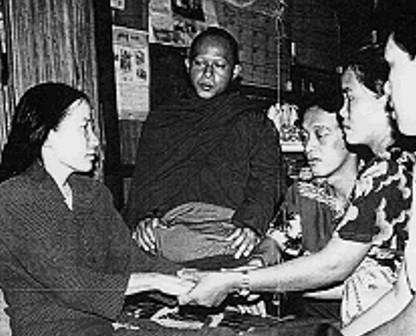
Cambodia’s Buddhist leadership responded by signaling its willingness to cooperate through pagoda-based advocacy, HIV/AIDS prevention work by monks, and care for people living with HIV/AIDS. The pagoda network offers an especially important channel in Cambodia, where not everyone has access to television or radio, but virtually every community can reach a temple or a monk.
In April 2001, with UNICEF support, a delegation of Cambodian Buddhist leaders traveled to Thailand to study practical ways of cooperating in HIV/AIDS prevention and care by learning from the Thai Buddhist experience.
In Thailand, where HIV/AIDS had emerged earlier as a major social crisis, the Buddhist community had long urged people not to discriminate against those living with HIV and had encouraged more responsible behavior. From around 1993 onward, especially in northern and northeastern Thailand, monks began working directly with HIV-positive people, putting their teachings into practice and urging society to live with compassion rather than exclusion.
“Simply preaching religious principles is not enough to save people living with HIV who are suffering from discrimination,” said Thai monk Phra Phongthep. “What matters is not words alone, but the message we send through concrete action. If we tell people to stop discriminating against those with HIV, then we ourselves must first stand beside them and put Buddhist teachings into practice.”
The activities of Thai monks vary from pagoda to pagoda. They include caring for AIDS orphans, running hospices, operating meditation centers for people living with HIV, supporting income-generation projects in cooperation with NGOs, providing HIV/AIDS education in temples, and making home visits to families affected by AIDS.
Cambodian Buddhist leaders who visited Thailand said they were deeply encouraged by what they saw: countless monks and nuns caring for AIDS patients with compassion, and many people living with HIV gradually recovering their dignity and self-respect after having been wounded by discrimination.
“Thailand’s experience in effectively mobilizing Buddhist teachings and monks to implement HIV/AIDS measures in temples, temple-run educational institutions, and universities can be of great value to Cambodia as well,” said H.H. Buo Kry, Supreme Patriarch of the Dhammayuth sect. “In Cambodia, the Buddhist order is still rebuilding, and many monks and nuns remain illiterate and lack experience. But in the near future, we hope to equip them with the knowledge and skills they need so that, as in Thailand, the Buddhist community can take the lead in HIV/AIDS prevention and care and help show Cambodian society the right path forward.”
The Cambodian government, for its part, is encouraged by Thailand’s achievements and hopes to draw on the continuing moral authority of Cambodia’s Buddhist community, especially in rural areas where monks still exert strong influence over public attitudes. Officials also hope monks can serve as models of abstinence, helping to delay sexual activity among young people, whose sexual behavior is reportedly beginning at increasingly earlier ages.
“Support from religious leaders, especially Buddhist monks, is extremely effective in carrying out HIV/AIDS programs at the grassroots level,” said Dr. Tia Phalla of the National AIDS Authority (NAA). “Monks embody positive qualities such as loyalty and integrity, and when people see them helping AIDS patients, it does much to dispel prejudice among ordinary Cambodians.”
Nhean Sakhen, a social worker with Banteay Srei, said attitudes at village level were already beginning to shift.
“In the past, when someone in a village was found to have HIV/AIDS, even the family became the target of prejudice,” Sakhen said. “But as monks went from place to place explaining how HIV is transmitted, how people can live safely alongside those infected, and why communities should support rather than reject them, villagers’ attitudes toward people living with HIV/AIDS have begun to change.”
Beyond Medical Care: The Need for Spiritual Healing
For Cambodia, however, the Thai model cannot simply be copied.
“Most temples in Cambodia were destroyed during the Pol Pot era, and most experienced monks were killed,” said Dr. Mey Nay of UNICEF. “Cambodia is therefore not in a position, like Thailand, to organize hospitals or hospices systematically around pagodas.”
“At this stage, the most effective approach is to train monks and establish a system in which they can visit households caring for AIDS patients and provide spiritual support,” Mey Nay said. “In a home-based care system centered not on pagodas but on families, the patients’ relatives are the key actors, and the understanding and cooperation of the wider community are indispensable.”
He stressed that the challenge of HIV/AIDS extends well beyond physical illness.
“What matters is not only the patient’s physical condition, but also mental and emotional well-being — whether the person feels accepted by family and community,” he said. “Alongside monks’ home visits and counseling, we want to foster, through public awareness efforts, a social environment in which people can confront HIV/AIDS as a shared issue rather than as a source of stigma.”
INPS Japan