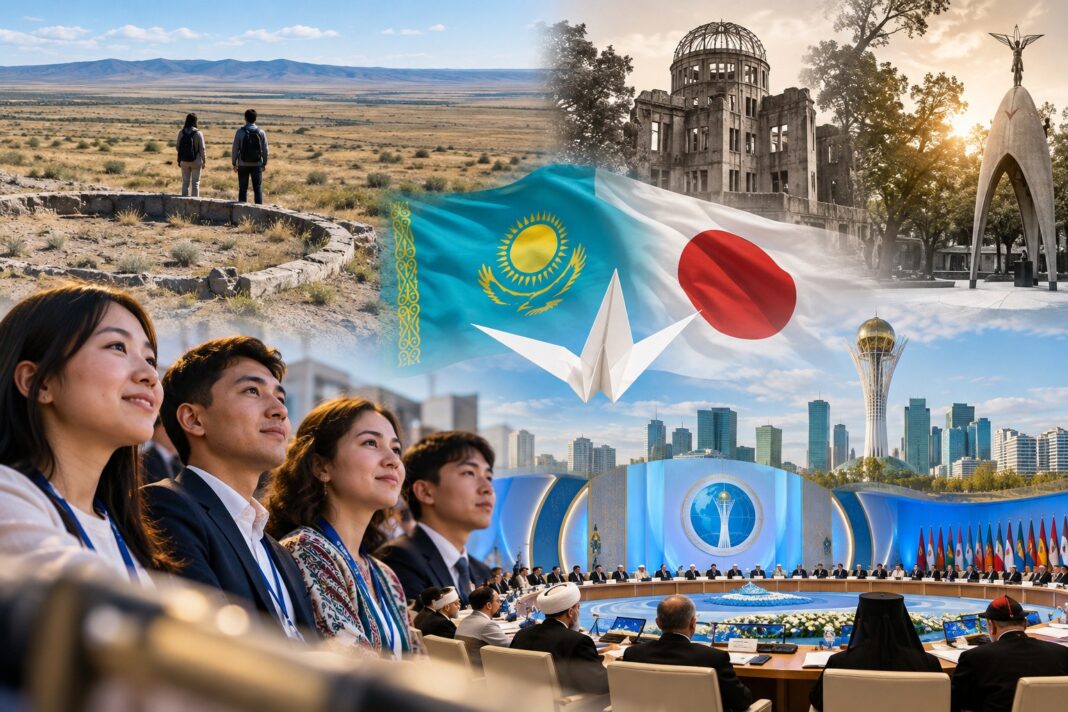
Drawing on the experiences of Hiroshima, Nagasaki and Semipalatinsk, SGI has worked with Kazakhstan’s Foreign Ministry and United Nations mission to advance nuclear abolition. That cooperation is now extending into youth peace education and other initiatives through an institution supporting the Congress of Leaders of World and Traditional Religions.
By Katsuhiro Asagiri
ASTANA/Tokyo (INPS Japan) — The atomic bombings of Hiroshima and Nagasaki and decades of nuclear testing at Semipalatinsk left Japan and Kazakhstan with different histories of nuclear suffering. Those experiences have helped sustain a partnership that is now finding new avenues through interfaith dialogue.|JAPANESE|
Soka Gakkai International, or SGI, has worked with Kazakhstan’s Foreign Ministry, its United Nations mission and civil society organizations to explain the humanitarian consequences of nuclear weapons and bring governments and activists together to discuss disarmament.
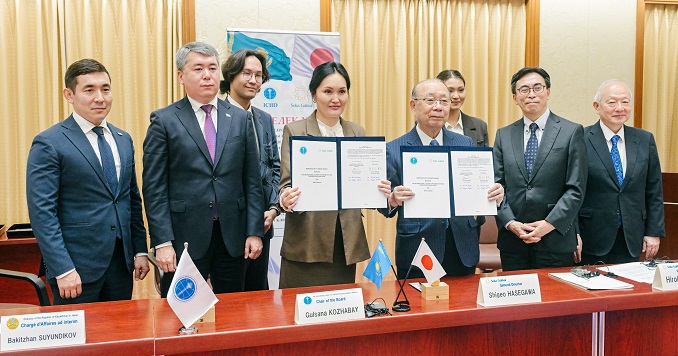
The Congress of Leaders of World and Traditional Religions is providing another setting in which that cooperation can develop. On June 30, Soka Gakkai and Kazakhstan’s International Center for Interfaith and Interreligious Dialogue, known as ICIID, signed a memorandum of understanding in Tokyo. They are now discussing practical initiatives, including preserving the memory of nuclear suffering and educating young people about peace.
“The priority is not to create another programme on paper, but to identify two or three areas where we can do something together and demonstrate real results,” Gulsana Kozhabay, the center’s board chair, said in written responses to INPS Japan.
Yoshiyuki Nagaoka, executive director of Soka Gakkai’s Office of Public Affairs, who represented the organization at last year’s eighth congress, said in a separate written interview that the memorandum had brought their cooperation into “a new stage.”
Their responses point to an effort to build on existing disarmament partnerships by bringing survivors’ testimony and peace education more fully into the interfaith forum’s work.
A Partnership Rooted in Nuclear Experience
For Kazakhstan, disarmament is inseparable from national history.
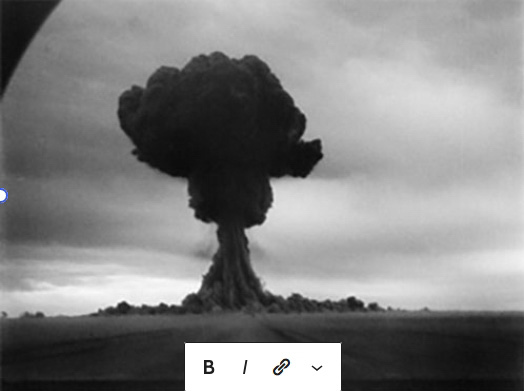
The Soviet Union conducted 456 nuclear tests at Semipalatinsk between 1949 and 1989. Kazakhstan closed the site in August 1991, shortly before independence, and subsequently relinquished the nuclear weapons left on its territory after the Soviet collapse.
The circumstances of the atomic bombings in Japan and the nuclear tests in Kazakhstan were different, as were the patterns of harm. But the two countries share a responsibility to convey the enduring consequences for health, communities and the environment — and to prevent others from suffering them.
Kozhabay said the humanitarian dimension was particularly important at a time when nuclear weapons were increasingly discussed in terms of deterrence and strategic balance.
“These histories give both our countries a particular responsibility to keep the human consequences of nuclear weapons visible,” she wrote.
Soka Gakkai representatives began participating in the Congress at Kazakhstan’s invitation in 2018. The following year, an SGI delegation visited Semey and the former Semipalatinsk nuclear test site.
Soka Gakkai emphasized the significance of its delegation having witnessed the realities of the site firsthand and said it hoped to explore opportunities for more people to visit and deepen their commitment to peace and nuclear abolition.
Those exchanges have also helped produce a tangible record of suffering: I Want to Live On: The Untold Stories of the Polygon, a documentary made through cooperation between SGI and Kazakhstan’s nongovernmental Center for International Security and Policy, or CISP.
SGI described the film as a project developed with an NGO through exchanges dating back to 2018. It brings the experiences of people affected by nuclear testing into the debate over nuclear weapons.
Building on Diplomatic Cooperation
SGI’s partnership with Kazakhstan has also developed in settings where governments and civil society meet.
SGI and Kazakhstan’s U.N. mission have co-hosted side events at Meetings of States Parties to the Treaty on the Prohibition of Nuclear Weapons and during Preparatory Committee sessions for Nuclear Non-Proliferation Treaty Review Conferences. These gatherings, he said, have brought together government officials and civil society representatives to help build international support for nuclear abolition.
In 2023, SGI worked with Kazakhstan’s Foreign Ministry, the International Committee of the Red Cross, the International Campaign to Abolish Nuclear Weapons, CISP and other partners to support a regional conference on the humanitarian consequences of nuclear weapons and the Central Asian nuclear-weapon-free zone. Representatives of all five Central Asian states participated.
In March 2025, Kazakhstan’s U.N. mission, CISP and SGI co-hosted a screening of the documentary at the United Nations alongside a nuclear-ban treaty meeting, connecting communities’ experiences with international policy discussions.
“What matters, I believe, is that these efforts continue, rather than remain one-off initiatives,” Nagaoka said.
He expressed a determination to deepen exchanges with Kazakhstan and build further examples of cooperation between civil society and intergovernmental diplomacy.
The memorandum with ICIID does not replace those relationships with the Foreign Ministry, the U.N. mission or nongovernmental organizations. Rather, the interviews suggest an effort to draw on their accumulated experience for new educational and exchange programs within an interfaith framework.

From Religious Dialogue to Peace Education
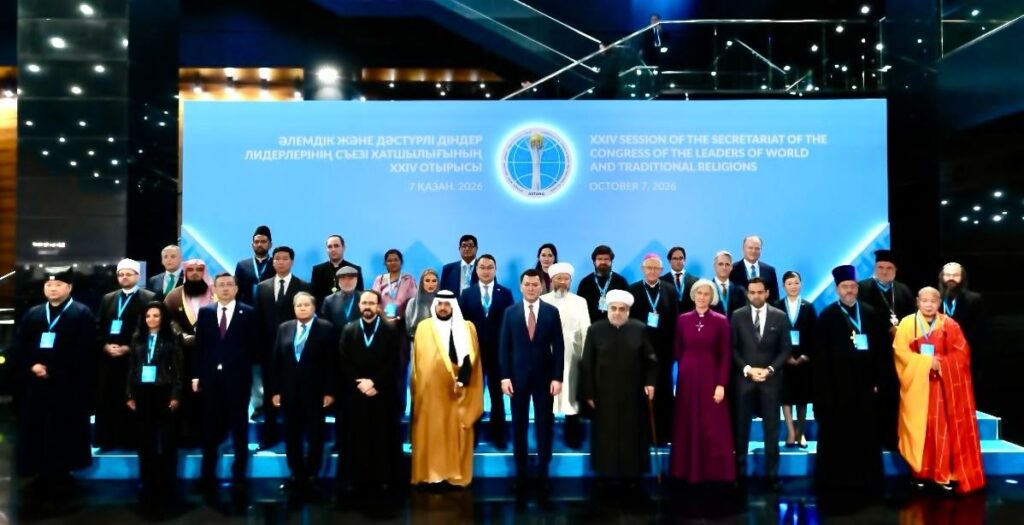
Founded in 2003, the Congress has established a continuing forum for representatives of different faiths. At its 24th Secretariat meeting in Astana on Oct. 7, participants repeatedly asked what the trust built through those encounters should now produce.
“The opportunity is to walk together and not just talk together,” Bishop Jo Bailey Wells of the Anglican Communion told delegates.

Mohamed Abdelsalam, secretary-general of the Muslim Council of Elders, warned that “a declaration that is not implemented loses its functionality.” He called for clear responsibilities and follow-through that could be assessed against results.
Kozhabay sees youth peace education as a starting point for cooperation with Soka Gakkai. She proposed connecting the experiences of Hiroshima, Nagasaki and Semipalatinsk through youth exchanges, educational programs and public dialogue.
Drawing on the experience of Soka educational institutions in peace education and nuclear abolition education, Soka Gakkai is also exploring the possibility of sharing educational programs for young people through cooperation with Kazakhstan.
One project already under discussion is a Kazakh-language edition of six essays on peace by the late Daisaku Ikeda, former president of SGI. Editions already existed in English, Russian and Uzbek, with publication in Kazakh planned for 2027.
The book is not the partnership’s overarching objective. It is one initial undertaking intended to encourage young people to think about peace.
Kozhabay said she did not want cooperation confined to a predetermined list of projects. She welcomed Soka Gakkai’s proposals for joint publications, educational materials and cultural exchanges, as well as opportunities for her center to participate in the organization’s international initiatives.
“For me, a genuine partnership should work in both directions,” she said.
Putting Shared Ethics Into Practice
The potential areas of cooperation extend beyond nuclear abolition and peace education.
At the October meeting, the Secretariat adopted a document on religions’ role in addressing climate change and an ethical code for artificial intelligence in religious contexts.
Kozhabay similarly proposed bringing religious leaders, researchers, technology specialists and young people together to discuss digital manipulation, reliable religious information and human responsibility.
Japan’s Association of Shinto Shrines, Jinja Honcho, also contributed to the climate document. Its involvement illustrates how cooperation with Japan draws on more than one religious tradition.
Both documents are advisory, however. Further discussions are also needed before proposals for educational use of the documentary, environmental cooperation or AI-related exchanges become new joint programs. Existing achievements and prospective projects must be distinguished.
The meeting also supported a Kazakhstan–Holy See initiative concerning the rights of children with incurable diseases. The common thread connecting these different subjects is an effort to translate shared ethical convictions into cooperation that protects human dignity.
Turning Trust Into Results

Vice President Erlan Karin, who chaired the meeting, emphasized the need to turn decisions into action. He asked the Secretariat and its partners to prepare a concept and phased plan for a proposed Global Movement for Peace, with initial results in 2027, ahead of the ninth congress in 2028.
Kozhabay was explicit about the limits of the Congress’s authority.
“The Congress cannot negotiate arms-control treaties, and it should not pretend to replace governments, diplomats or international legal mechanisms,” she wrote.
Its contribution, she said, was to preserve awareness of nuclear weapons’ humanitarian consequences, engage younger generations and maintain dialogue across political divides. Even without negotiating agreements, it could help build the public, ethical and humanitarian support needed to sustain them.
That is where the two interviewees’ views converge: remembering nuclear suffering should not be confined to looking backward. Education and international cooperation can carry that memory into decisions about the future.
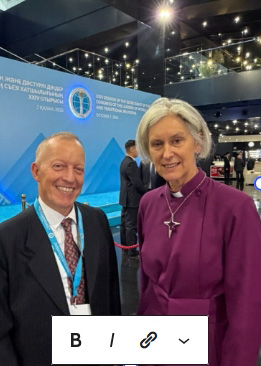
After the Oct. 7 meeting, Paolo S. Affatato of the Catholic news agency Agenzia Fides asked Bishop Bailey Wells whether spiritual diplomacy actually influenced politics. This correspondent audio-recorded the exchange.
“Certainly, I think it does have impact,” she replied, while expressing a wish for greater influence at government level.
“There’s nothing like meeting in person to build those relationships,” she said.
What those relationships produce is the next question. Cooperation developed over years between SGI and Kazakhstan’s diplomatic institutions and civil society is now informing discussions of new projects with ICIID.
For Kozhabay, success over the next decade should be measured not simply by the number of meetings held, but by what was “actually created, implemented or changed” because people came together.
For those seeking to preserve the memories of Hiroshima, Nagasaki and Semipalatinsk, that is more than a question about the future of interfaith dialogue. It is a question of what can be done now to prevent nuclear suffering from being repeated.
This article is brought to you by INPS Japan in collaboration with Soka Gakkai International in consultative status with UN ECOSOC.

INPS Japan
Related Articles:
Kazakhstan Has Spent 23 Years Bringing Faiths Together. Now Comes the Harder Part.
From Semei to Hiroshima: Astana Times Editor on Bringing Global Solidarity Through Journalism