
The seventh World Forum on Intercultural Dialogue brought together participants from more than 100 countries, highlighting how youth-led peace initiatives, cultural diplomacy, interfaith cooperation and artificial intelligence can help turn dialogue into meaningful action.
By Katsuhiro Asagiri
BAKU, Azerbaijan (INPS Japan) — At a time when wars, geopolitical rivalries and growing polarization are deepening divisions across the world, how can trust be built among people of different cultures, religions and traditions?
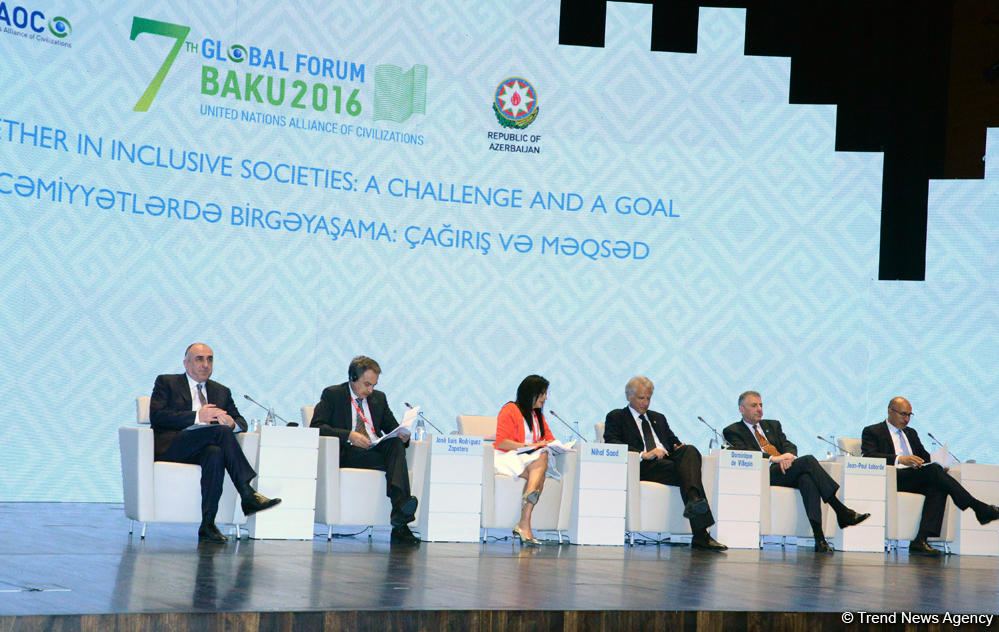
The seventh World Forum on Intercultural Dialogue, held in Azerbaijan from October 27 to 29, underscored the importance of international efforts to address that question.
Under the theme “Dialogue for a Shared Future: Building Bridges in a Divided World,” the gathering brought together representatives of governments, international organizations, religious communities, cultural institutions and civil society.
According to Azerbaijani President Ilham Aliyev, more than 2,000 people registered for the forum, including over 500 international participants from more than 100 countries.
The forum grew out of the Baku Process, an international initiative launched by Azerbaijan in 2008 to promote intercultural dialogue. The first World Forum on Intercultural Dialogue was held in 2011.
Fifteen years later, it has developed into an international platform where representatives of different civilizations, religions and cultures exchange perspectives and explore opportunities for cooperation and peaceful coexistence.
In his opening address, Aliyev emphasized that the forum had evolved beyond discussions of intercultural relations to address a broad range of pressing international challenges.
He also referred to the initialing of a peace agreement between Azerbaijan and Armenia in Washington in August 2025, reflecting on changes in relations between the two countries after years of conflict.
His remarks offered an opportunity to consider how dialogue and reconciliation relate not only to cultural understanding but also to regional stability and international cooperation.
Turning Dialogue Into Lasting Cooperation
The forum was organized by Azerbaijan’s Ministry of Culture in cooperation with several international organizations, including the United Nations Educational, Scientific and Cultural Organization (UNESCO), the United Nations Alliance of Civilizations (UNAOC), the Islamic World Educational, Scientific and Cultural Organization (ICESCO) and UN Tourism.
Its program covered a broad range of issues, from ministerial-level policy discussions and youth exchanges to interfaith cooperation, cultural heritage preservation and the growing influence of artificial intelligence.
Miguel Ángel Moratinos, the U.N. High Representative for the Alliance of Civilizations, emphasized the importance of intercultural dialogue in building peaceful societies.
Dialogue alone, he observed, cannot end wars, nor can it replace diplomacy, international law or the responsibilities of political leaders.
Yet dialogue remains indispensable to building lasting peace.
Peace agreements may bring violence to an end, but overcoming the divisions and mistrust left by conflict requires sustained efforts to foster mutual understanding and rebuild relationships among communities.
At another session, Moratinos stressed that dialogue should not become an end in itself. Its true value lies in its ability to generate sustained action and tangible benefits for people and communities.
That understanding was reflected in several initiatives presented during the forum.
Young People Turn Dialogue Into Action
One of the most encouraging developments was the active participation of young people.
Ahead of the main forum, an international youth gathering in Guba, northern Azerbaijan, brought together 80 young people from 44 countries.
Participants from diverse cultural backgrounds exchanged ideas on mutual understanding and peacebuilding, creating opportunities to build friendships and partnerships across national boundaries.
UNESCO also presented evidence of how young people are translating dialogue into concrete initiatives in their communities.
Through the first phase of its Youth Peace Programme, 50 young leaders from 48 countries received training and mentoring.
Their efforts subsequently generated 48 initiatives across 46 countries, with an estimated combined reach of 1.12 million people.
During the Baku forum, UNESCO announced a second phase of the program, focusing on human connection and dialogue in the age of artificial intelligence.
These initiatives demonstrate how intercultural dialogue can extend beyond the principles discussed at international conferences and become a driving force for education, community engagement and practical peacebuilding.
Can Artificial Intelligence Bridge Cultural Divides?
Artificial intelligence was among the subjects that attracted considerable attention at the forum.
Katalin Annamaria Bogyay, president of the Hungarian National Commission for UNESCO, suggested that AI could become “a bridge between cultures and languages.”
Coşkun Yılmaz, Turkey’s deputy minister of culture and tourism, described how the technology is being used to document and preserve cultural heritage and combat the illicit trafficking of cultural property.
AI holds considerable potential to support the preservation of cultural diversity and expand opportunities for communication across linguistic boundaries.
At the same time, participants acknowledged the risk that technological advances could reinforce existing divisions or create new ones.
Sanja Vlaisavljević, the culture minister of Bosnia and Herzegovina, warned against allowing AI to become an instrument of manipulation, discrimination or inequality.
Mario Maruška, a state secretary in Slovakia, expressed concern that the expanding use of AI could diminish the visibility of smaller cultures and minority languages.
Similar concerns had been raised just a day before the Baku forum opened.
At a peace gathering in Assisi, Italy, on October 26, Lucio Caracciolo, editor of the Italian geopolitical journal Limes, delivered a stark assessment.
“AI is not a technology, it is a weapon,” he declared.
The contrasting perspectives expressed in Assisi and Baku highlighted a fundamental challenge: the decisive question is not simply how rapidly AI develops, but which ethical principles and human values guide its use.
In Baku, participants also examined practical ways to address that challenge.
UNESCO introduced an Intercultural Digital Competencies Framework designed to incorporate cultural empathy, multilingual communication, understanding of different perspectives and ethical judgment into digital education.
The initiative seeks to ensure that digital technologies contribute to mutual understanding rather than deepen cultural divisions.
The forum also demonstrated how AI could be used creatively to convey messages of peace.
At the closing ceremony on October 28 at the Heydar Aliyev Center, an AI-powered artistic program titled “One Humanity” brought together, in a digitally imagined dialogue, two of the twentieth century’s most celebrated cellists: Mstislav Rostropovich, who was born in Baku, and Pablo Casals of Spain.
Both musicians were renowned not only for their extraordinary contributions to music but also for their commitment to human dignity and freedom.
By bringing their artistic legacies into an imagined conversation, the presentation used emerging technology to communicate a message of peace across generations and cultures.
It offered a symbolic example of how technological innovation, when guided by humanistic values, can help strengthen cultural connections.
Japan’s Min-On Joins the Dialogue Through Cultural Diplomacy
Japan was also represented at the forum through a delegation from the Min-On Concert Association, a cultural organization founded in 1963 by Daisaku Ikeda.
Min-On has long promoted international cultural exchange through music and the performing arts, seeking to foster friendship and mutual understanding among people of different nations and cultural backgrounds.
According to the November 11 edition of the Seikyo Shimbun, Min-On Representative Director Yamaguchi and other members of the delegation participated in the forum on October 27 and 28.
On October 27, they attended an event devoted to peacebuilding through cultural diplomacy.
Following the session, they met with Moratinos, the U.N. High Representative for the Alliance of Civilizations.
The Min-On representatives introduced the philosophy behind the organization’s founding and described its history of promoting international cultural exchange.
Moratinos, according to the report, expressed his willingness to cooperate in efforts to advance peacebuilding.
The following day, the delegation attended a session on museums and cultural heritage, engaging with representatives of governments and cultural organizations from different countries.
Min-On’s relationship with Azerbaijan predates the forum.
In April 2026, Farid Talibov, Azerbaijan’s ambassador to Japan, visited the Min-On Culture Center in Tokyo and exchanged views with Yamaguchi and other representatives on opportunities to strengthen cultural exchange.
The delegation’s participation in Baku illustrated how sustained engagement by cultural organizations and civil society can complement government diplomacy and help build trust among people across national and cultural boundaries.
Such exchanges can provide a foundation for future cooperation, extending the impact of international dialogue beyond formal diplomatic settings.
Interfaith Dialogue Opens New Paths Toward Peace
Interfaith cooperation was another important dimension of the Baku gathering.
A plenary session on interreligious dialogue examined the role of religious communities in promoting reconciliation and overcoming intolerance.
Salim M. AlMalik, director general of ICESCO, highlighted the organization’s network of approximately 300 young “peace ambassadors” working in more than 80 countries.
He described dialogue as both a responsibility of leadership and a foundation for peace.
These initiatives are part of a broader international effort to strengthen cooperation among religious communities.
Approximately three weeks before the Baku forum, the secretariat of the Congress of Leaders of World and Traditional Religions met in Astana, Kazakhstan, and adopted 11 ethical principles concerning the use of artificial intelligence in religious contexts.
The principles address human dignity, freedom of conscience and the risks of algorithmic manipulation, reflecting efforts by religious communities to bring ethical perspectives to the development and application of new technologies.
The Astana meeting also discussed the role of religions in responding to climate change.
Kazakhstan and Azerbaijan share several important characteristics.
Both are secular states with predominantly Muslim populations, located at strategic crossroads in Eurasia.
Both have invested in international platforms designed to promote dialogue across religious and cultural boundaries.
Their continuing efforts reflect a broader recognition that religious and cultural differences need not be sources of confrontation. Instead, communities representing different traditions can become partners in the pursuit of peace.
Connecting Dialogue to a Shared Future
The achievements presented at the Baku forum went beyond the scale of international participation.
UNESCO demonstrated how youth engagement can generate concrete initiatives at the community level and introduced a framework to strengthen intercultural understanding in an increasingly digital world.
Cultural organizations expanded opportunities for exchange, while religious leaders and representatives of international institutions emphasized the importance of translating mutual understanding into sustained cooperation.
At the same time, the forum highlighted the need to deepen these efforts and ensure that their benefits reach public policy and everyday life.
Organizers announced plans to publish a final document containing recommendations emerging from the discussions. As of November 14, the official publication of that document could not be confirmed.
UNESCO, meanwhile, called on governments to make intercultural understanding a policy priority in education, digital governance, urban development, employment and security before the next forum, scheduled for 2028.
Integrating the principles of dialogue into institutions and public policy will be an important part of the next stage.
At the October peace gathering in Assisi, Cardinal Fridolin Ambongo Besungu of Kinshasa, Democratic Republic of the Congo, offered a concise expression of what peacebuilding requires.
“Peace is made among adversaries,” he said.
Dialogue cannot, by itself, resolve every dispute or end every conflict.
But lasting peace depends on the willingness of people with different perspectives to listen to one another, build relationships of trust and work together on shared challenges.
Over the past 15 years, the Baku forum has helped expand the international space for such encounters.
This year’s gathering demonstrated the potential of culture, religion, education and technology to strengthen those connections and encourage practical cooperation.
In a world marked by deepening divisions, the forum’s vision of a “shared future” is more than an abstract ideal.
It represents a practical aspiration: to enable people of different cultures and civilizations to respect their diversity while working together to build peace.
This article was produced as part of the SDGs for All project, a joint media initiative of INPS Japan and Soka Gakkai International (SGI).