
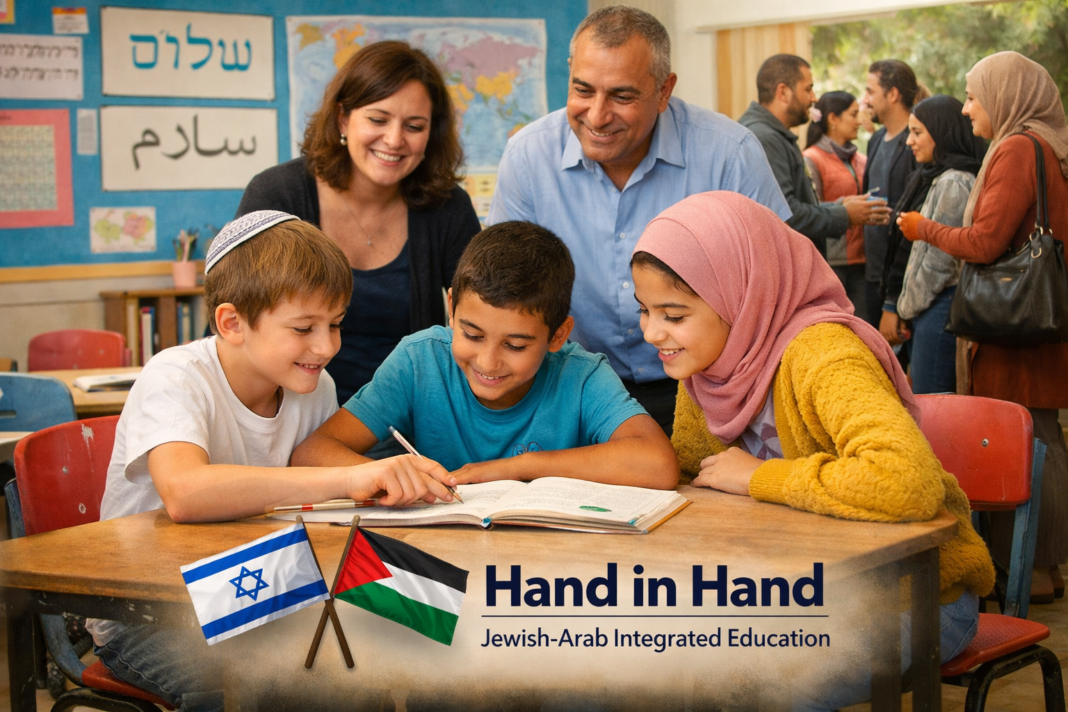
“Yad be-Yad” in Hebrew, or “Yadn be-Yadn” in Arabic, The Hand in Hand is one out of eight bilingual and fully integrated Jewish-Arab educational networks in Israel. Its mission is to build bridges of understanding between the two alienated societies.
By Roman Yanushevsky
Jerusalem (INPS Japan) – The Hand in Hand: Center for Jewish-Arab Education in Israel is a unique educational network that was established with the goal of creating a shared society between Jewish and Arab citizens of Israel.
It was founded in 1997–1998 by two educators – Israeli Arab teacher Amin Khalaf and Israeli-American teacher Lee Gordon. It began very modestly, with around 50 children studying in two initial schools – one in Jerusalem and one in the Galilee.|JAPANESE|RUSSIAN|
As of today, it offers full primary to secondary school education in Israel. This network consists of six elementary schools, five preschools, two middle schools and one high school in six locations. It serves more than 2,000 students from the age of three to 18, studying in six campuses across Israel: Jerusalem, the Galilee, Wadi Ara, Tel Aviv-Jaffa, Haifa, and Kfar Saba.
Each school functions not only as an educational institution but also as a community hub promoting dialogue and shared civic life.
“Hand in Hand was established to combat one of Israel’s greatest existential threats: the growing social alienation and lack of trust between Jewish and Arab citizens of Israel. We believe that education is key in changing this”, – the founders say.

Lee Gordon and Amin Khalaf, sought to challenge the prevailing separation in the Israeli education system by creating schools where Jewish and Arab children could learn together on equal footing. So their organization emerged against the backdrop of deep social divisions and ongoing conflict, with a vision to foster mutual understanding, equality, and coexistence through bilingual and integrated education.
From its inception, Hand in Hand has operated on the belief that education is one of the most powerful tools for social change. The organization established its first school in Jerusalem, bringing together students, teachers, and families from both communities. In 2023 this school, called by the name of British philanthropist Max Rayne, won an award for overcoming adversity and was called one of the world’s best schools by UK-based T4 Education.
Mutual and bilingual
A defining feature of Hand in Hand schools is their bilingual and bicultural approach. Instruction is conducted in both Hebrew and Arabic, with equal emphasis on both languages. Each classroom is co-taught by two teachers – one Jewish and one Arab – who serve as role models of partnership and equality. This structure ensures that students grow up hearing, speaking, and valuing both languages and cultures on a daily basis.
The curriculum in Hand in Hand schools is designed to reflect the narratives, histories, and identities of both Jewish and Arab communities. Rather than avoiding difficult topics, the schools encourage open discussion about history, identity, and conflict. Students are exposed to multiple perspectives and are taught critical thinking skills that allow them to engage with complex realities in a respectful and informal manner.
Equality is a core principle of the network. Hand in Hand emphasizes that both groups – Jewish and Arab – must have equal representation, voice, and influence within the school environment. This extends beyond the classroom to school leadership, parent involvement, and community activities. The organization actively works to ensure that no group dominates the other, fostering a genuine sense of partnership.

Another important aspect of Hand in Hand’s philosophy is the concept of shared society. The schools aim not only to educate children but also to influence the broader society by building relationships among families and communities. Parents are encouraged to participate in joint activities, dialogue sessions, and community-building initiatives, creating a wider network of cooperation beyond the students themselves.
The Tel Aviv–Jaffa campus is a notable example of this model in action. Located in a diverse and often divided urban area, the school brings together Jewish and Arab families from different socioeconomic and cultural backgrounds. It serves as both an educational institution and a community center, hosting events, workshops, and dialogue programs aimed at strengthening social cohesion.
Hand in Hand also places a strong emphasis on democratic values and civic engagement. Students are encouraged to take part in discussions about social justice, human rights, and equality. Through various programs and activities, they learn the importance of active citizenship and the role they can play in shaping a more inclusive society.
The challenges are also here
Despite its successes, the network has faced significant challenges. These include political tensions, social resistance, and, at times, acts of hostility against its schools and communities. Nevertheless, Hand in Hand continues to grow, driven by the commitment of educators, parents, and supporters who believe in its mission.
Over the years, the organization has gained recognition both within Israel and internationally as a pioneering model of integrated education. Its graduates often demonstrate higher levels of tolerance, empathy, and cross-cultural understanding compared to their peers in segregated school systems. Many remain engaged in initiatives promoting coexistence later in life.
In addition to its formal education programs, Hand in Hand runs community outreach initiatives aimed at fostering dialogue between Jewish and Arab adults. These include leadership programs, cultural events, and joint civic projects. The goal is to extend the impact of the schools into the broader society and contribute to long-term social change.
This article is brought to you by INPS Japan in collaboration with Soka Gakkai International in consultative status with UN ECOSOC.

INPS Japan
Roman Yanushevsky is a journalist and editor based in Israel. Specializing in Middle Eastern affairs, he continues to report and write on Israeli politics and security, nuclear policy, regional diplomacy, and the challenges of coexistence. He is also a regular contributor to INPS Japan, where he conveys the region’s complex realities from an international perspective.