


By Roman Yanushevsky
Jerusalem (INPS Japan) – In the spring of 2026, Israel launched one of the most unusual immigration operations in modern Jewish history: a government-backed effort to bring thousands of members of the Bnei Menashe community from northeastern India to Israel. For Israeli officials, the project is not merely another aliyah (immigration to Israel – R.Y.) campaign. It is being described as the continuation of an ancient historical return – the arrival of descendants of one of the Biblical “Ten Lost Tribes of Israel.” |RUSSIAN|JAPANESE|
Bringing the nation together

The first major flight under the new initiative landed at Ben Gurion Airport in April 2026, carrying approximately 240 immigrants from the Indian states of Mizoram and Manipur. The operation, known as “Wings of Dawn,” marked the beginning of a broader state-funded plan approved by the Israeli government in late 2025.
According to the Israeli government and the Jewish Agency for Israel, around 1,200 members of the Bnei Menashe community are expected to arrive in Israel by the end of 2026. The long-term plan aims to relocate nearly the entire remaining community – approximately 5,000 to 6,000 people – by 2030.
This makes the current operation one of the largest organized aliyah campaigns involving a community associated with the Lost Tribes tradition in modern history. Israeli officials have openly framed the project in ideological and historical terms. Prime Minister Benjamin Netanyahu called the initiative “important and Zionist,” while Aliyah and Integration Minister Ofir Sofer described it as part of Israel’s national mission of collecting exiles.
The operation is also deeply connected to family reunification. Thousands of Bnei Menashe have already immigrated to Israel over the past two decades, often leaving relatives behind in India because of bureaucratic limits and changing Israeli immigration policies. The new plan is intended to complete the relocation of the remaining families.
Today, roughly 5,000 members of the Bnei Menashe community already live in Israel, according to the Israeli organization “Shavei Israel”, which has played a central role in supporting their aliyah since the early 2000s. Most are settled in northern Israel, including communities in the Galilee and around Nof HaGalil and Kiryat Yam.
Who exactly are the Bnei Menashe?
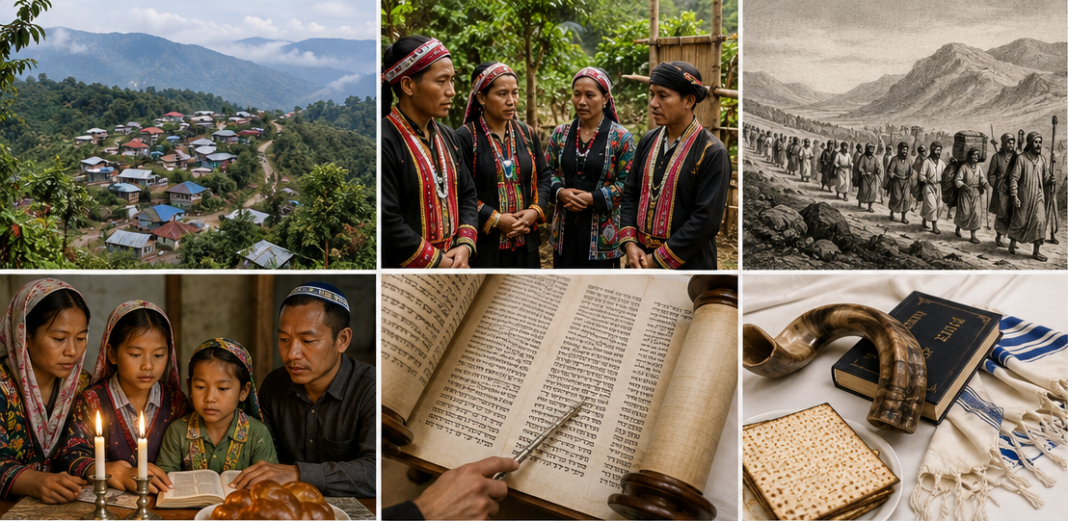
The community originates primarily from the Chin, Kuki and Mizo tribal populations living in India’s remote northeastern borderlands near Myanmar and Bangladesh. They speak Tibeto-Burman languages and historically practiced local tribal religions before large-scale Christian missionary activity transformed the region during the nineteenth and twentieth centuries.
The modern Bnei Menashe identity emerged gradually during the twentieth century. Community traditions preserved stories about an ancient homeland called “Sinlung” or “Chinlung,” and oral narratives describing a migration from a distant western land. In the 1950s, some tribal leaders began connecting these traditions to the Biblical story of the Tribe of Manasseh – one of the Ten Lost Tribes exiled after the Assyrian conquest of the northern Kingdom of Israel more than 2,700 years ago.
Over time, thousands of people in these communities began adopting Jewish practices. They observed Shabbat, celebrated Biblical holidays, avoided certain foods and embraced Hebrew prayers. Eventually, leaders from the community contacted Israeli religious authorities and organizations asking to reconnect formally with the Jewish people and immigrate to Israel.
A turning point came in 2005, when Israel’s Sephardi Chief Rabbi officially recognized the Bnei Menashe as descendants of Israel. However, because of uncertainties surrounding their exact ancestry and centuries of separation from mainstream Judaism, members of the community were still required to undergo formal conversion before receiving citizenship under Israel’s Law of Return.
The main organization behind the aliyah effort has been Shavei Israel, founded by former Israeli official Michael Freund. The group has funded religious education programs in India, assisted with conversions and coordinated immigration flights for years.
The Mystery of the Ten Lost Tribes
The story of the Bnei Menashe fascinates many Israelis precisely because it touches one of Judaism’s oldest historical mysteries: the fate of the Ten Lost Tribes.
According to Biblical and historical tradition, ten of the twelve tribes of ancient Israel disappeared after the Assyrian Empire conquered the northern Kingdom of Israel in the eighth century BCE. Over centuries, legends emerged across the Jewish world about isolated peoples who might preserve traces of those tribes.
What makes the Bnei Menashe case unusual is that this is not simply a symbolic or spiritual claim. Thousands of people identifying with a possible Lost Tribe tradition are immigrating to Israel collectively, receiving formal religious recognition and integrating into Israeli society as Jews. There are few modern precedents for a migration of this scale connected specifically to Lost Tribes narratives.
At the same time, historians and genetic researchers remain cautious.
There is currently no definitive archaeological, documentary or genetic proof that the Bnei Menashe are direct descendants of the ancient Tribe of Manasseh. Most scholars describe the connection as plausible but unproven. The strongest evidence comes from oral traditions, certain ritual similarities and the community’s long-standing sense of Israelite identity. Critics argue that some aspects of modern Bnei Menashe Judaism developed relatively recently, particularly during the twentieth century.
Even within Israel, opinions differ. Some religious authorities see the Bnei Menashe as authentic remnants of ancient Israelite populations that became isolated in Asia over centuries. Others view them as sincere converts inspired by Biblical traditions rather than direct biological descendants of ancient Israelites. The Israeli government itself has largely avoided making definitive historical claims, instead emphasizing the community’s commitment to Judaism and Zionism.
The current aliyah operation is also unfolding against the backdrop of instability in northeastern India. Ethnic violence in Manipur since 2023 displaced many members of the community and accelerated efforts to complete the migration process. Community leaders described the new Israeli initiative as both a humanitarian mission and a fulfillment of a decades-long dream.
For many Israelis, the emotional power of the story lies not in scientific certainty but in historical symbolism: after thousands of years, people living in remote mountain regions of India are arriving in the Jewish state believing they are returning home.
The Bnei Menashe are not the only group associated with Lost Tribes theories

Among the most frequently discussed communities are the Beta Israel of Ethiopia, whose Jewish identity was formally recognized by Israel and who immigrated in large numbers during Operations Moses and Solomon. Many traditions connect them to the Tribe of Dan, though historians continue debating the exact origins of the community.
Another group often mentioned is the Pashtuns of Afghanistan and Pakistan. Certain Pashtun tribes preserve oral traditions linking themselves to ancient Israelites, and some tribal names resemble Biblical tribal names. However, mainstream historians regard the evidence as highly inconclusive.
The Lemba people of southern Africa are another notable case. Genetic studies have identified Middle Eastern markers among parts of the Lemba priestly clans, making them one of the few groups outside the Jewish world with some measurable evidence of ancient Near Eastern ancestry. Even so, scholars remain divided over whether this reflects ancient Israelite origins specifically or broader historical Middle Eastern migration.
Communities in Central Asia, among Kurdish populations, and among certain groups in China and Japan have also been linked at times to Lost Tribes theories, though in most cases the evidence is fragmentary or largely folkloric.
What distinguishes the Bnei Menashe is that their story moved beyond legend into state policy. In 2026, planes are landing, families are arriving, and an ancient Biblical narrative – whether historically provable or not – is being woven into the modern story of Israel itself.
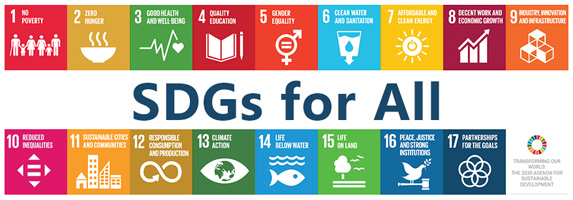
P.S. At least four UN Sustainable Development Goals could be related to this story:
United Nations SDG 10 – Reduced Inequalities
The aliyah process for the Bnei Menashe is fundamentally about the integration of a marginalized and geographically isolated minority into Israeli society. Many members of the community come from economically underdeveloped regions in northeastern India and face linguistic, educational and employment barriers after immigration.
United Nations SDG 16 – Peace, Justice and Strong Institutions
The Bnei Menashe case involves questions of legal recognition, citizenship, religious status and institutional inclusion. The operation is also often framed as a peaceful humanitarian migration initiative rather than a refugee crisis or conflict-driven displacement.
United Nations SDG 4 – Quality Education
Education plays a major role in the Bnei Menashe aliyah process. Before and after immigration, many participants undergo Hebrew-language instruction, Jewish studies, vocational education, and cultural orientation programs.
United Nations SDG 11 – Sustainable Cities and Communities
Many Bnei Menashe immigrants are settled in peripheral Israeli communities in the Galilee and northern Israel. It helps to strengthen their communities and regional populations while preserving cultural diversity. The story also touches on safeguarding intangible cultural heritage – traditions, identity and communal continuity.
This article is brought to you by INPS Japan in collaboration with Soka Gakkai International in consultative status with UN ECOSOC.

INPS Japan