
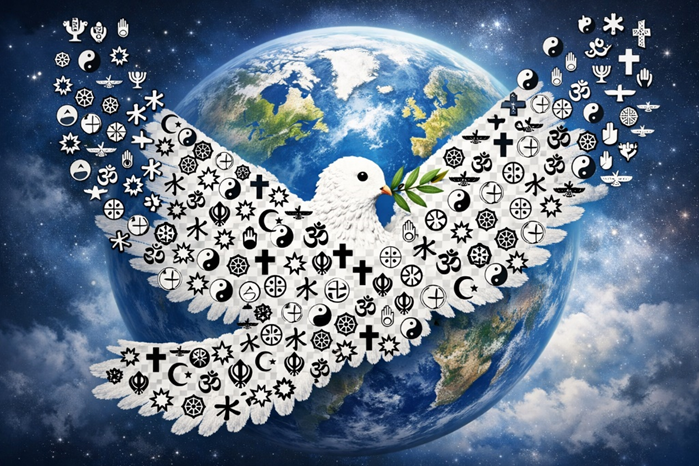
While religion has at times been used to justify violence or division, it can also serve as a force for peace by promoting dialogue and encouraging societies to take a more active role in conflict resolution.
By Guillermo Ayala Alanis
Mexico City(INPS Japan) – In an international climate shaped by wars involving the United States, Iran and Israel, as well as the conflict between Russia and Ukraine, the world appears to be drifting toward a new era of global confrontation, one in which the risk of nuclear conflict is rising sharply. Beyond the political, strategic and economic dimensions, however, there is another, less visible but still influential factor: religion and its role in building peace.|JAPANESE|SPANISH|
Although wars were once justified in the name of God, particularly during periods such as the Middle Ages, religions today tend to play a more conciliatory, if less prominent, role in an increasingly secular world, where political decision-making often seems detached from compassion and respect for others.
While religion has sometimes been used as a pretext for attack or self-defense, it can also be a force for peace, fostering dialogue and encouraging societies to take a more active role in demanding that their leaders resolve conflicts at a time when rearmament is gaining momentum.
In this context, José Sols, a specialist in political theology and a professor at the Universidad Iberoamericana in Mexico City, warned that the world has returned to a climate of tension reminiscent of the Cold War. In an interview with INPS Japan, Dr. Sols said that although the influence of religion on international politics has diminished, its presence within societies remains significant, allowing messages of peace to continue resonating with millions of believers.
“We must move from passive waiting to active hope… Building peace is a task. Too often, we as citizens think others—politicians or diplomats—will take care of it, but that is a mistake. Peace begins with coexistence, with human relationships, and is therefore also the responsibility of the church,” he said.
The Importance of Promoting Dialogue for Peace
According to the United Nations, the world’s population now exceeds 8 billion, including some 2 billion Muslims, 1.4 billion Catholics out of a total of 2.4 billion Christians, 500 million Buddhists and more than 15 million Jews—figures that reflect the continued significance of religion in global society.
Examples of this influence can be seen in several countries. Iran defines itself as an Islamic republic; in Israel, some political movements are shaped by religious Zionism; and in the United States, the tradition of taking the presidential oath of office on a Bible remains a powerful symbol.
Since the latter half of the 19th century, interfaith dialogue initiatives—symbolized by the 1893 World’s Parliament of Religions in Chicago—have brought together leaders of the world’s major religious traditions and helped lay the groundwork for peaceful coexistence by fostering mutual understanding among peoples and cultures.
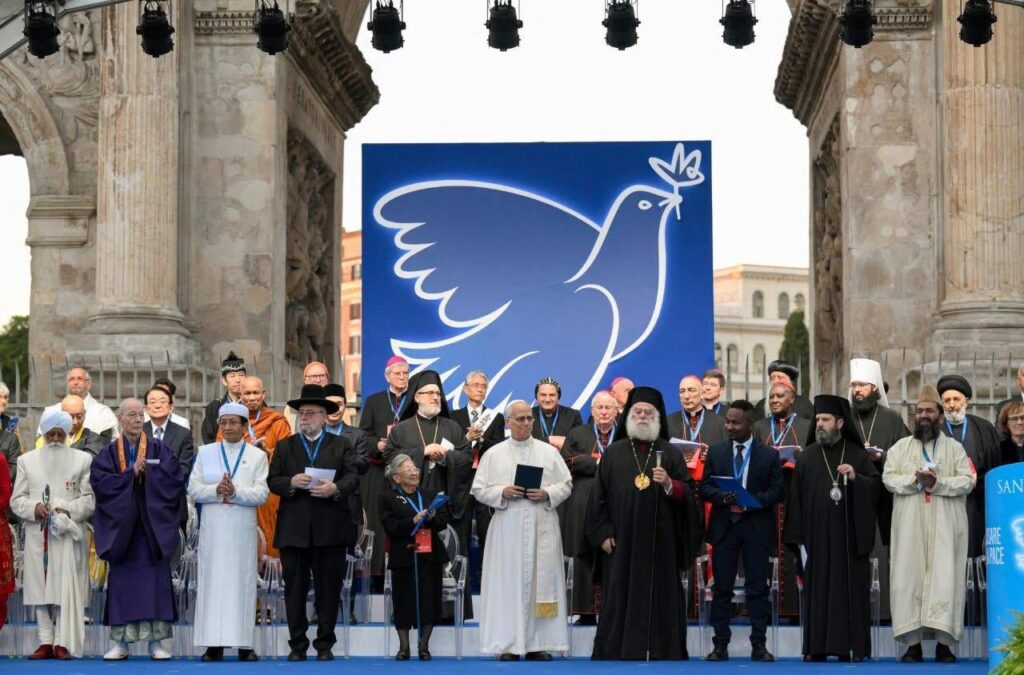
In recent years, the Catholic world has also seen such efforts. The Pontifical Academy for Life has launched an international appeal titled “Scientists for Peace,” arguing that in an age when drones and increasingly sophisticated weapons are being deployed on the battlefield, science and technology should be used not for war but for peace and human dignity. Last October in Rome, the Community of Sant’Egidio hosted the “International Meeting for Peace: Dialogue and Prayer,” bringing together priests, rabbis, imams, monks, and a wide range of religious leaders and civil society representatives, including representatives of Soka Gakkai International (SGI). At a time when fear, nationalism, and war cast a deep shadow over the world, the gathering renewed a central question: how faith can be linked not to division, but to coexistence and a shared responsibility for peace.
Nuclear Rearmament and a New Challenge: Artificial Intelligence
Reflecting on the growing nuclear threat, Dr. Sols said the rearmament of these weapons of mass destruction now presents an additional danger: the use of artificial intelligence. He warned that AI systems operate automatically and may be unable to account for factors beyond those built into their programming.
“We loaded AI with many algorithms but forgot to include the one that says, ‘Be careful. In this case, do not do that.’ In that way, a nuclear war could begin without human intervention,” he said.
He also warned of the resurgence of imperial rhetoric in international politics, saying it has pushed aside inclusive narratives and seeks to impose the law of the strongest without regard for the human consequences of armed conflict.
“Building a human life takes many years, but destroying it takes only a second,” he said.
The Church as an Ally in Conventional Disarmament
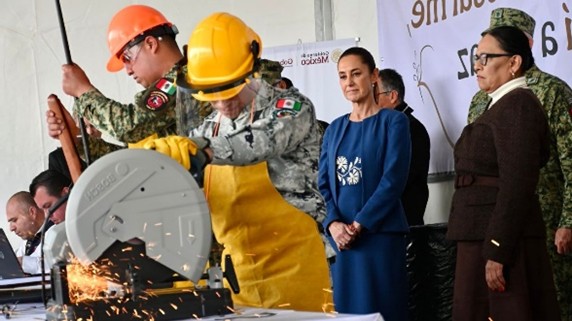
Religious activism in favor of disarmament also seeks to address more immediate local concerns and to draw on the trust many people place in religious institutions. In Mexico, which the civil society organization Armed Conflict Location and Event Data (ACLED) has described as the fourth most dangerous country in the world, the Catholic Church has worked with the government of President Claudia Sheinbaum on the “Sí al desarme, sí a la paz” (“Yes to Disarmament, Yes to Peace”) program. Under the initiative, church courtyards are made available so that citizens can voluntarily and anonymously hand over firearms to military personnel for destruction in exchange for financial compensation.
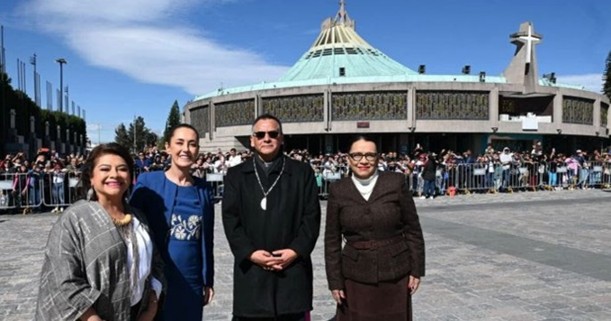
The program has been implemented in densely populated areas such as Mexico City and its metropolitan region, as well as in other states with high levels of violence, including Baja California, Colima, Guanajuato, Guerrero, Oaxaca, Puebla and Tabasco.
At a time when global rearmament is advancing and the nuclear threat persists, religious communities are seeking to ensure that their conciliatory voice—one that promotes dialogue—continues to resonate with millions of believers, reminding them that peace depends not only on governments, but also on the daily actions of societies.
This article is brought to you by INPS Japan in collabpration with Soka Gakkai International in consultative status with the UN’s Economic and Social Council (ECOSOC).

INPS Japan