



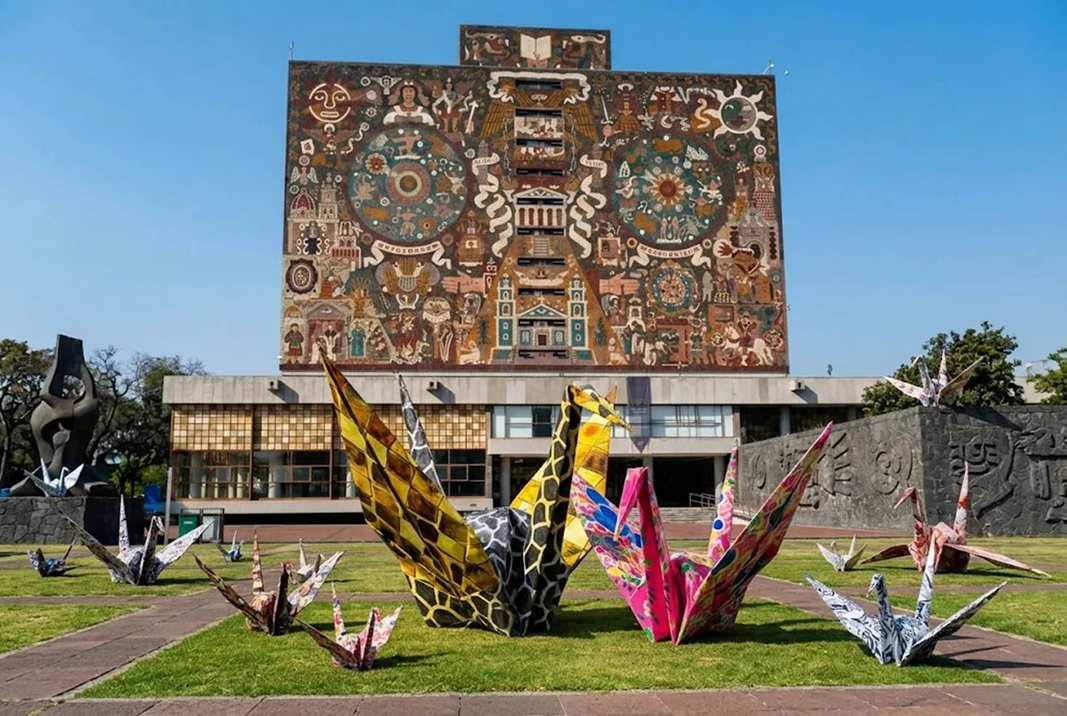
An exhibition that blends Japanese culture and Mexican folklore through origami cranes made by staff at the UNAM Central Library as part of its 70th anniversary celebration.
By Guillermo Ayala Alanis
Mexico City(INPS Japan) – In 1972, when she was just four years old, Japanese-born artist Mari Sano visited the Central Library of the National Autonomous University of Mexico (UNAM) for the first time. Accompanied by her father, who had been an exchange student in Mexico, she was impressed by the murals covering the building. More than five decades later, that little girl returned to the same venue, but this time to share an art project that brings together life stories, memories, and messages of peace in an expo: «70 años, 70 historias de grullas» (70 Years, 70 Crane Stories).|JAPANESE|SPANISH|
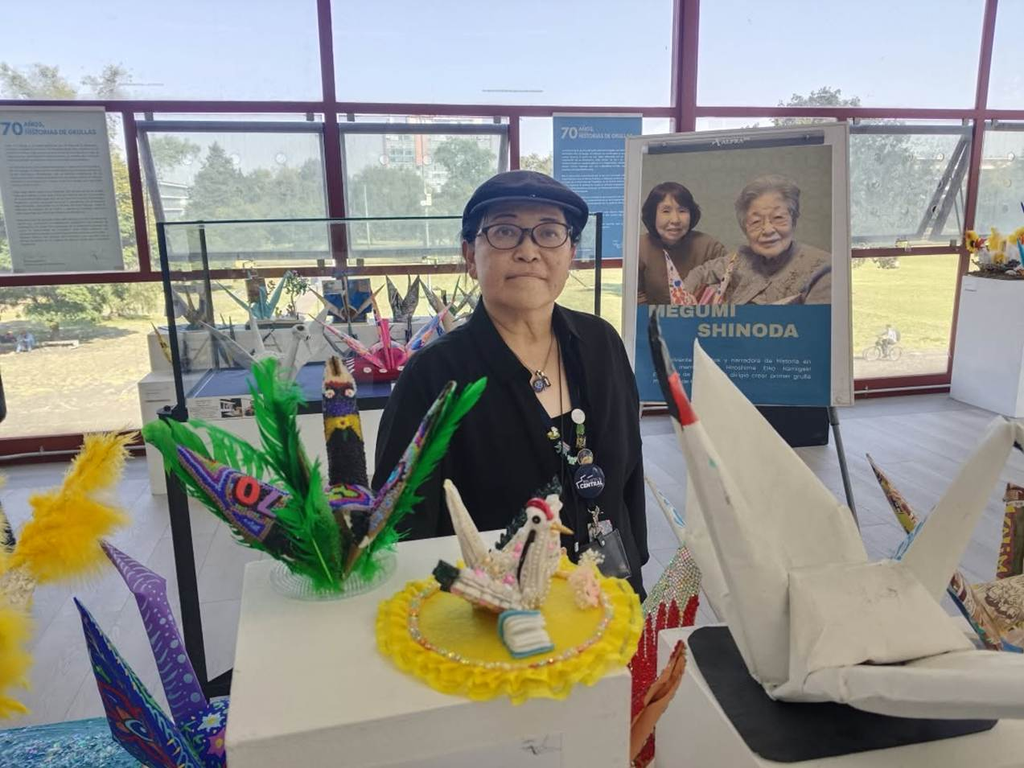
The exhibition, installed in the Central Library as part of the activities marking the building’s 70th anniversary, brings together creations by university library staff who, using the technique of cartonería (A traditional Mexican craft technique that involves modeling and sculpting figures using paper, paste, and a supporting structure) and their creativity, gave shape to a crane with its own meaning. Some represent personal experiences; others draw on architectural and symbolic elements of the building; but all share a common story.
“My father, who studied at the School of Economics, explained to me what the murals were about. Beyond his explanation, I couldn’t believe all the artwork that surrounded me. I felt that this work conveyed a message of humanity, unity, and peace. I kept that feeling with me and thought I’d come back to see it someday, but I never imagined I’d be sharing it and getting involved in a project with the Central Library. It’s a tremendous honor,” recalled Mari Sano, who found in Mexican culture a source of inspiration that led her to develop a proposal combining the symbolism of the Japanese crane with Mexican creativity and artisanal techniques.
The Mexican crane project began to take shape in 2015, when the idea arose to create an offering for peace at the José Martí Cultural Center, in collaboration with Mexican artist Felipe Coraza. Using the cartonería technique, a large-scale crane was created, giving rise to a distinctive style and an artistic concept that, since then, has found a place in museums, cultural centers, universities, and hospitals.
Now, after 18 months of work and meetings with the university community, the cranes created by Central Library staff have made their way to the campus Reading Room to be displayed for visitors.
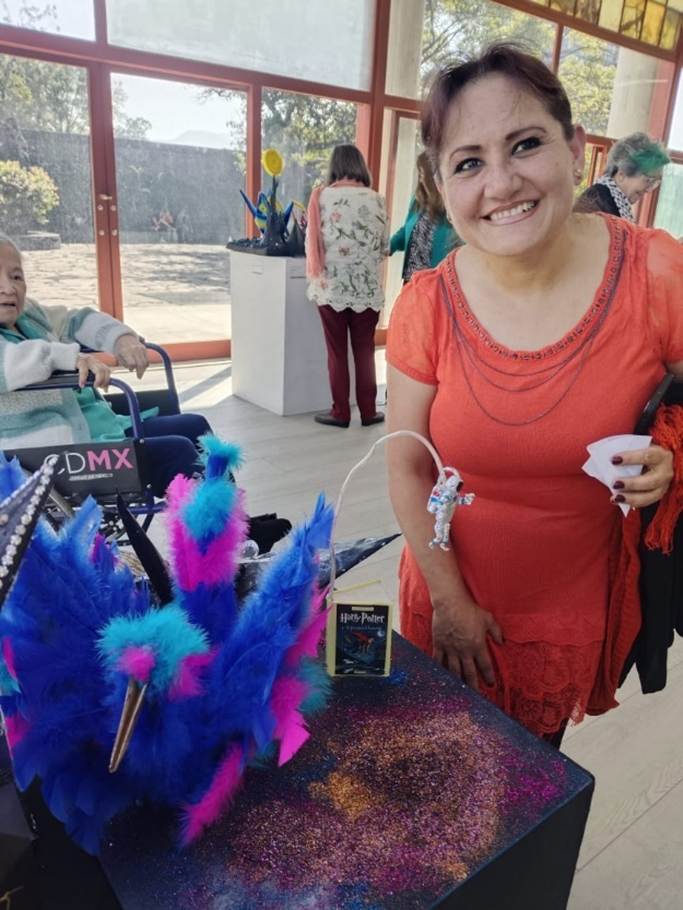
For Verónica de León, who has worked at the library for ten years, creating a piece inspired by the Harry Potter story was a way to express resilience. The book accompanied her during a difficult period in her life marked by surgery. “I had spinal surgery and went through a very severe depression. The only book that helped me get through it was Harry Potter,” she said. For her, the crane represents that ability to move forward after going through difficult times.
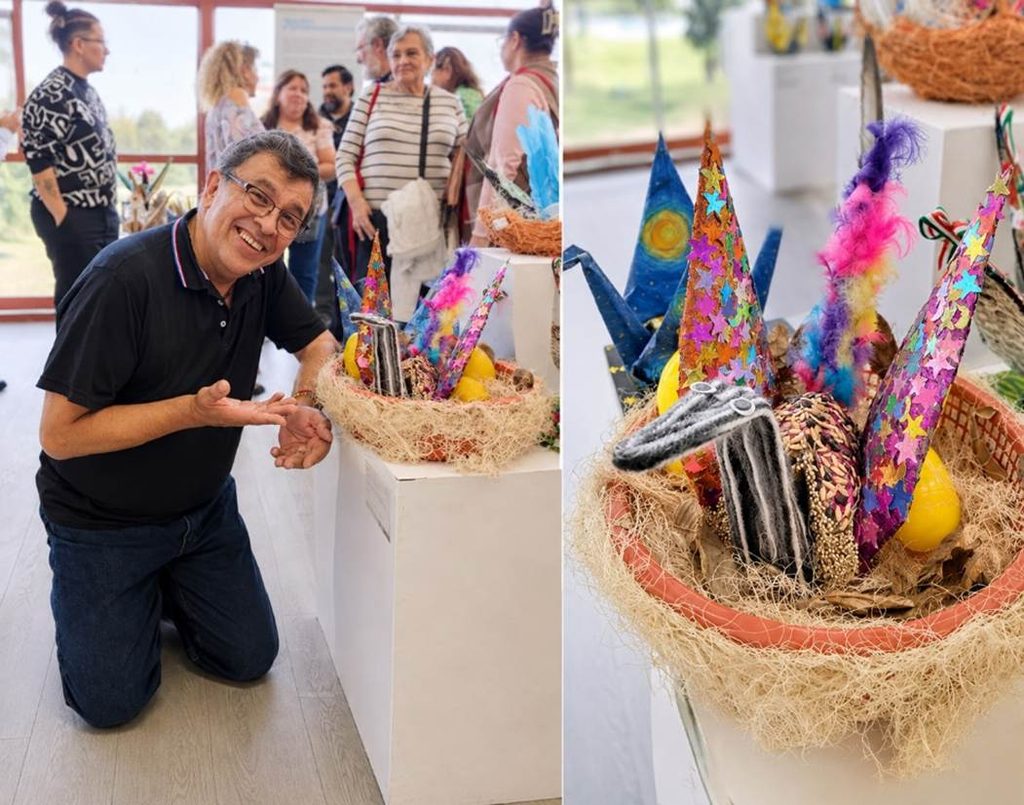
Agustín Contreras’s creation, meanwhile, became a family project. Four generations participated in the creation of his crane, represented by five members of his family: his 84-year-old mother; his sister; his niece; his five-year-old grandniece; and himself. Each contributed an element to the piece: stars, moons, glitter, yarn, seeds, and feathers. They also incorporated a nest as a symbol of home.
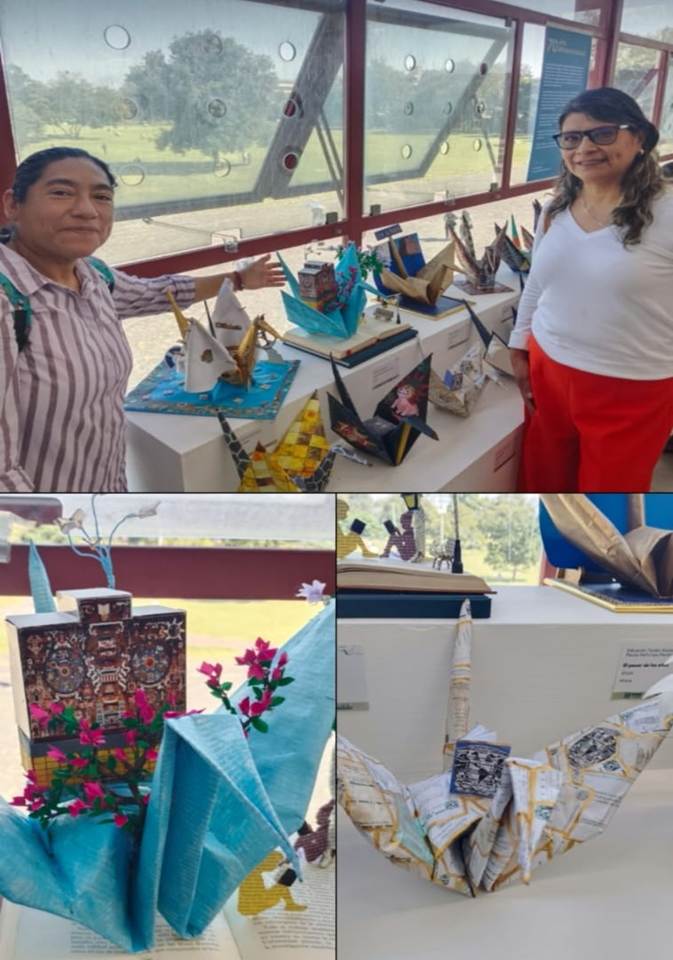
The Central Library also found a way to travel on the wings of the cranes. In their work “Humanity, Nature, and Culture,” Rocío Osario Martínez and Silvia Patricia Juárez revive the image of this iconic building and illustrate how knowledge and reading can extend beyond a physical space. Their design features benches, people reading, and elements of nature—such as trees and flowers—that evoke the coexistence of books, nature, and human beings.
Another piece, created by Martha Urrutia and titled “Paper Dreams,” pays tribute to the theses housed in the Central Library. Thus, the creations not only replicate the building’s architecture but also capture part of the identity of those who work and spend their days there.
Nests also took on special significance among the pieces. For Cristina Ávila, a member of the Central Library community, these elements represent the life journeys of those who have dedicated a significant part of their lives to the library. “It caught our attention that the first pieces to arrive had, for example, a nest… it metaphorically represents the life journeys of workers who have spent their entire lives here, because the library is your home—it’s an extension of your home,” she explained.
For Elsa Margarita Martínez Leyva, general director of Libraries and Digital Information Services at UNAM, the exhibition allows for a connection to be drawn between the symbolism of the crane and the history of a venue that, for seven decades, has been a meeting place for generations of university students.
“Just like the crane, the Central Library has been making its mark on every user who has passed through its doors for 70 years. The library’s longevity not only preserves the memory of the past but also offers many tools for imagining and building new horizons,” she emphasized.
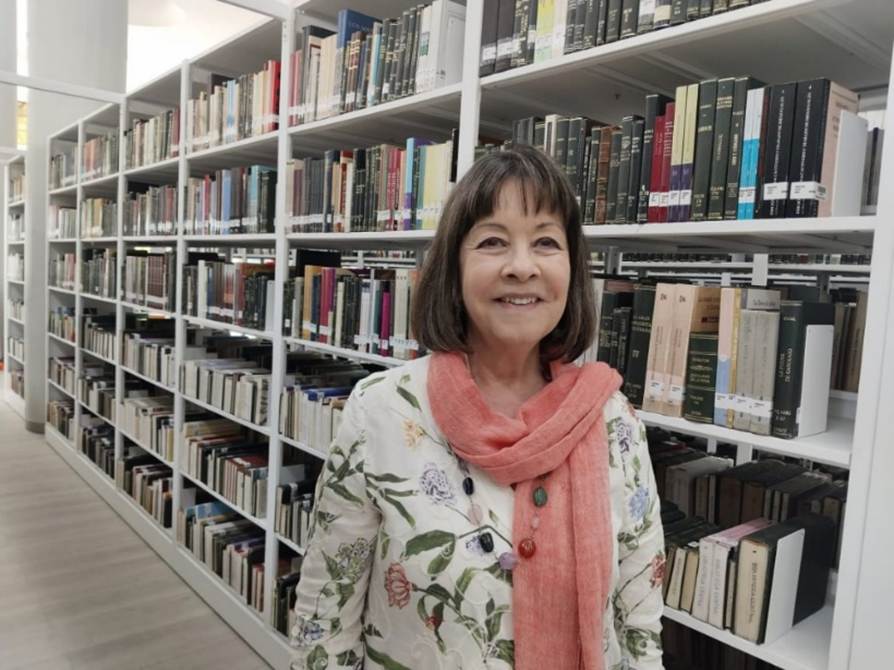
Author: Guillermo Ayala.
Designed by architect Juan O’Gorman, the Central Library houses a collection of approximately 600,000 books, as well as historical documents, theses, and reference materials. Its murals, created using thousands of stones of various colors, depict different moments in the history of Mexico and the university itself, and have made the building one of the architectural and cultural landmarks of UNAM.
However, for Martínez Leyva, the value of this space extends beyond its collections or architecture. It also lies in the people who use it and in the daily interactions that take place among students, researchers, and visitors of different ages and disciplines.
“How many people from different schools, ages, and professions are sitting together at a table here? Calm, peaceful, going about their business. Many leave happy because they discovered something, finished their work, or picked up the book they needed for their exam. It’s an atmosphere of warmth and peace,” he noted.
The exhibition also features a work created by Megumi Shinoda, a survivor of the atomic bombing of Hiroshima, in collaboration with Eiko Kamigaki, a storyteller at the Hiroshima Peace Memorial Museum. The piece, which is part of the history of the Mexican Crane, is displayed in a glass case and placed on a cushion as a sign of the utmost respect and recognition for its history. Its presence serves as a reminder of the crane’s origins as a symbol of peace and the importance of keeping alive the memory of those who experienced the consequences of war.
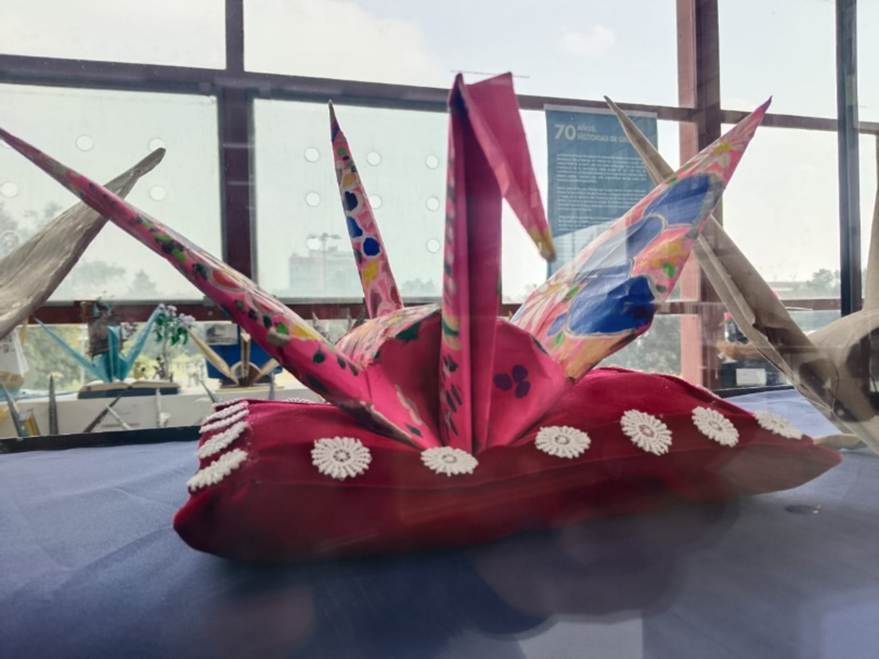
The crane has brought together people of different ages, backgrounds, and cultures. Its journey demonstrates how an artistic initiative can evolve through collective participation and find new meanings in every place it reaches.
The exhibition will remain open to the public through November 25 in the literature room of the UNAM Central Library.
INPS Japan
Related articles:
“Never again!” Nagasaki A-Bomb Survivor Appeals in Mexico
Sunrise in a Kayak: Xochimilco paddles towards a shared economy model